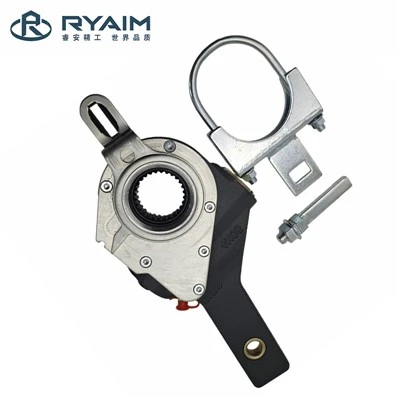
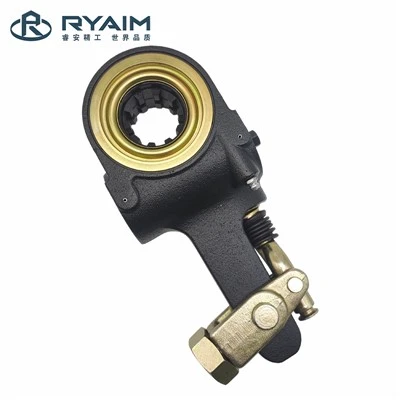
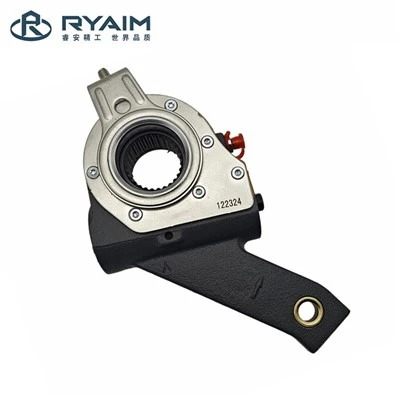
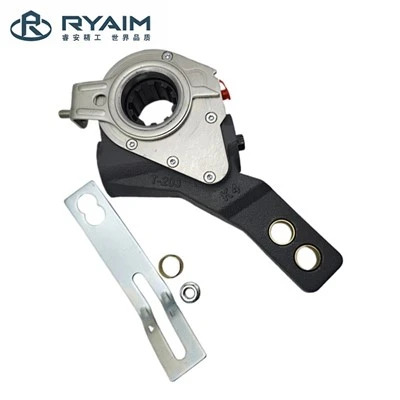
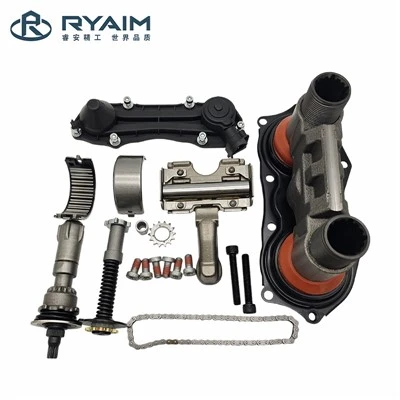
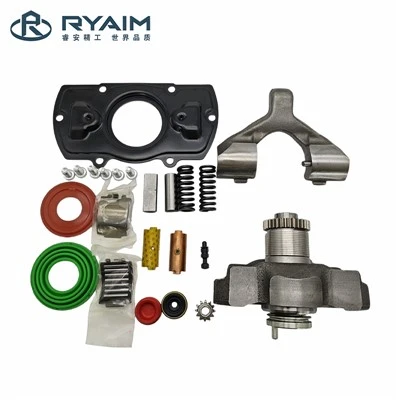
First, it must be clarified that the automatic slack adjusters currently used on trucks are technically mature; they have been widely adopted in developed nations across Europe and North America for many years and exhibit no obvious design flaws. In terms of technological sophistication, automatic slack adjusters offer numerous advantages: they constantly and automatically maintain the optimal clearance between the brake shoes and the brake drum while the vehicle is in motion, thereby ensuring consistent braking performance. Furthermore, they eliminate the drawbacks-such as unevenness-and the general hassle associated with manual brake adjustments.
However, I recently uncovered a very serious safety hazard. The issue arose with a 6x4 tractor unit that was just one year and five months old; the driver reported that the vehicle's braking performance was unsatisfactory. Upon initial inquiry, the situation struck me as rather peculiar. For a truck that was barely over a year old-featuring a comprehensive braking system comprising WABCO valves and air chambers on the tractor unit, FangSheng rear axles, automatic slack adjusters from a specific brand, and a WABCO 4-channel ABS system (with the trailer similarly equipped with 12-ton BPW axles and WABCO 4-channel ABS)-how could its braking performance be so poor after such a short period of service? Left with no other choice, I conducted a detailed inspection and discovered that on the tractor unit, the brakes on two wheels-specifically on the second and third axles-were completely non-functional.
Further examination revealed that the clearance between the brake shoes and the drums was excessively large. Consequently, when the brake pedal was depressed, the shoes failed to expand with sufficient force to generate adequate friction against the drums. This indicated that the automatic slack adjusters had failed and had completely lost their automatic adjustment capability. An even more critical issue emerged: although these slack adjusters are designed with a manual adjustment override, after manually adjusting the brakes back to proper working order, we found that-after just a few applications of the brake pedal during a test drive-the braking performance reverted to its original, failed state. A subsequent inspection revealed that the locking mechanism on the slack adjusters was unable to hold its position, causing the brakes to automatically slip back into a non-functional condition. This specific issue is not unique to this vehicle; similar situations have been observed on other trucks, and several fellow truckers have even told me that, within just two years of ownership, they have effectively replaced all their automatic slack adjusters with the older-style manual adjusters.
This brings us to the core issues:
1. Many truckers place blind faith in automatic slack adjusters, treating them as infallible, "miracle" components. Given that the mandatory standardization of automatic slack adjusters is a relatively recent development, truck drivers have not yet had extensive exposure to this new type of component and, consequently, lack a deeper, more comprehensive understanding of its operational nuances and potential limitations. Furthermore, since manufacturers often fail to provide adequate product explanations or usage instructions, we truck drivers-having placed our trust in the components-rarely bother to monitor or inspect them. Consequently, we remain completely unaware of when they might fail, never imagining that total failure could occur in just over a year. When a vehicle travels on wet or slippery surfaces, uneven braking force can easily trigger a skid (rendering even the most advanced ABS systems useless, as ABS is not a panacea in every specific environment). More critically, in emergency situations, the complete absence of braking force means the vehicle cannot be brought to a halt at all, leading to severe accidents.
Second, why does a critical component-one based on inherently mature technology-possess such a short service life? Why do foreign-made equivalents see widespread use without encountering such issues? This inevitably raises suspicions regarding product quality. In terms of technical characteristics, the automatic slack adjuster is pre-calibrated with a specific brake clearance value. As the vehicle's brake pads wear down during operation and the clearance exceeds the preset limit, the adjuster-upon returning to its resting position after a braking cycle-activates an internal one-way clutch mechanism. This mechanism reduces the clearance by one increment, thereby maintaining the brake clearance within the normal operating range. Much like a manual slack adjuster, each automatic adjustment requires a locking mechanism to secure the new position; however, we have observed that the failed and damaged adjusters we encounter are consistently unable to lock into their newly adjusted positions. Even after being manually adjusted, they revert to their pre-adjustment state after just a few applications of the brake pedal.
As I am not a technical expert, I cannot provide specific professional data; I can only infer the root cause of the problem based on my own practical experience. I previously owned a 6×4 tractor unit that suffered from this exact issue; within two years, I ended up replacing every single automatic slack adjuster with standard manual ones. I took this step because I felt the automatic adjusters lacked durability and presented unpredictable risks. Furthermore, their purchase price is several times higher than that of traditional manual adjusters: while a standard manual adjuster typically costs a few tens of yuan, an automatic one costs over 300 yuan. Based on the damaged automatic slack adjusters we have encountered-most of which failed after just over a year of service-I personally believe that the fundamental product design and technical principles are likely sound. The critical issue, in my opinion, lies in the quality of the materials used during manufacturing. Components made from high-quality materials should naturally possess a longer service life and certainly should not begin failing piecemeal after just a year or so (we have observed a particularly high number of failures occurring within the first two years). Naturally, before being developed and launched onto the market, products of this nature undoubtedly undergo extensive testing. They are also expected to meet specific requirements regarding operational frequency and service life. Since the internal mechanisms of the slack adjuster engage almost simultaneously every time the brakes are applied, the design must account for the maximum number of braking cycles-for instance, tens of thousands of times-that the components can withstand. Consequently, this imposes rigorous demands on the material composition of every single part within the slack adjuster assembly.
Thirdly, some truck drivers might remark, "I've been using this product for two or three years now, and it's worked perfectly fine." This is true; currently, many drivers in the market have yet to encounter any issues with this product. This discrepancy can be attributed to several factors. Foremost among them are the vast differences in road conditions under which vehicles operate. Vehicles traveling primarily on flat terrain or highways apply their brakes infrequently; consequently, they experience significantly less wear and tear during operation, leading to a perceived longer service life. Conversely, vehicles operating on secondary roads with complex conditions-or those traversing hilly and mountainous regions-require much more frequent braking, making them far more susceptible to developing mechanical issues.
Therefore, when selecting materials for their products, manufacturers must not base their service-life projections solely on usage patterns observed under the most ideal operating conditions. While these products do come with a warranty period (typically 18 months, as offered by manufacturers), I believe this 18-month timeframe is far from ideal. Given the immense variability in vehicle usage patterns-where vehicles operating frequently in mountainous or secondary-road environments face high braking frequencies and thus a higher probability of failure within that 18-month window-vehicles operating on flat terrain or highways, with their low braking frequencies, might easily function trouble-free for two or three years.
Furthermore, while there are national quality standards in place-specifically, the mandatory ISO/TS 16949:2002 certification-our country encompasses a vast territory with highly diverse topographical features. Consequently, some of these standardized benchmarks may diverge significantly from the realities of actual field operations. Judging by the issues that have surfaced thus far, it appears that the automatic slack adjuster should arguably be reclassified as a "consumable wear-and-tear part" within the scope of routine vehicle maintenance. However, given that this component is a critical safety device directly impacting human life, manufacturers must never-under any circumstances or for the sake of commercial gain-compromise on quality to the point of skirting the very edge of regulatory compliance.
Solemn Recommendation
In conclusion, I strongly urge manufacturers to recognize that there is no such thing as a "minor issue" when it comes to braking systems; these components hold the safety of countless lives and the happiness of countless families in their hands, and thus, there is absolutely no room for negligence or laxity. Manufacturers must strictly refrain from designing a product's service life to merely coincide with the expiration of the warranty period (the "Three Guarantees" period), nor should they rely on standards that lack a foundation in real-world operational realities as the sole metric for evaluating product quality. Whenever possible during product promotion, clearly specify the product's service life and provide a rational, scientifically grounded description of its performance capabilities. This ensures that end-users possess an accurate understanding of the product, enabling them to carry out proper maintenance and inspections to keep their vehicles in optimal mechanical condition at all times.
We also strongly urge truck manufacturers to exercise rigorous quality control when selecting components from suppliers. Do not allow quality issues with a specific brand of parts to tarnish the reputation of your own brand.
Furthermore, we strongly advise truck drivers to remain vigilant and conduct frequent inspections during operation. You never know when your braking system might suddenly lose stopping power across one or more wheels-a situation that poses a grave safety hazard. Remember: a safe journey home is the shortest route of all.